
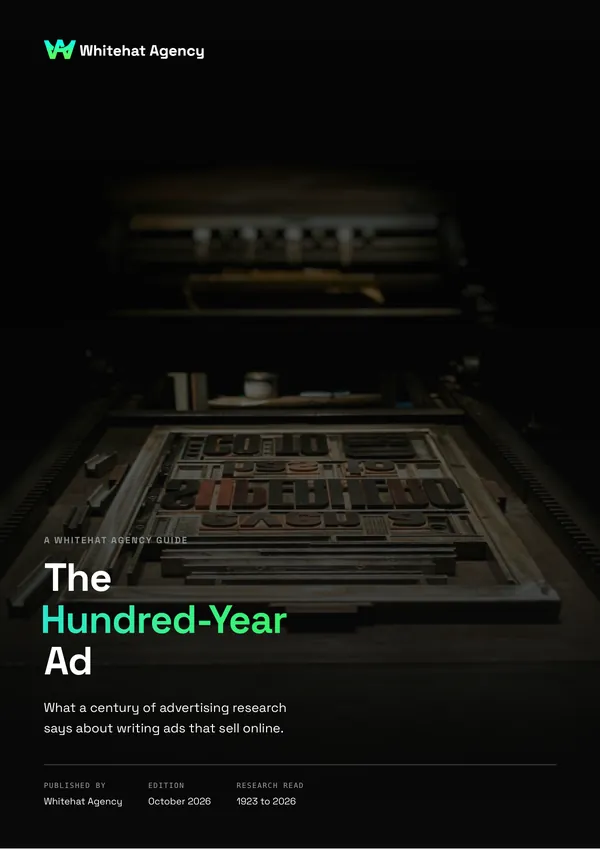
The Hundred-Year Ad: ad copywriting guide and AI skill Write Facebook and Instagram ads with a century of research behind them
A 131-page ad copywriting guide for Facebook and Instagram, drawn from the best-known ads and advertising research of the last 100 years and our own campaigns since 2013. With 40 real examples, 20 before-and-after rewrites and an AI skill you give to Claude, ChatGPT, Gemini, Copilot or any other AI assistant.
30-day money-back guarantee
We email your download link once the payment goes through.
We've run campaigns for






- 131 pages in the guide
- 40 real examples, credited
- 20 before-and-after rewrites
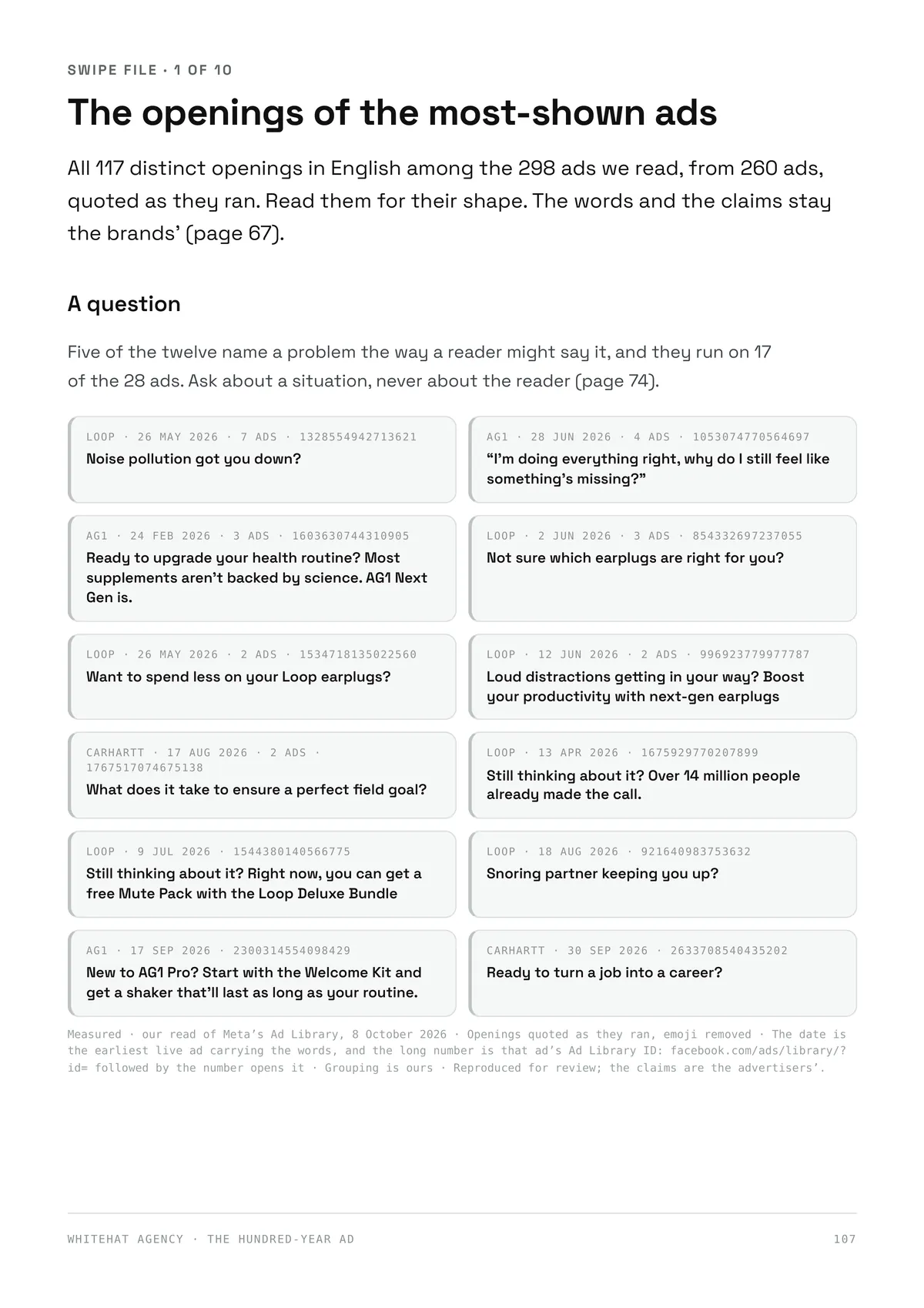
- 117 openings from live ads
- 7 worksheets, one per step
- 1 AI skill that writes and checks ads
A century of ads, and our own campaigns
We have run campaigns since 2013 for companies such as Salesforce, Commonwealth Bank, KPMG, Microsoft, Aldi and Velocity Frequent Flyer. Those campaigns have generated over $650 million in revenue for our clients.
For this guide we set what they taught us beside the best-known ads and advertising research of the last 100 years, and the most-shown Meta ads running today. The method in the guide is where they agree, and the skill hands that method to your AI assistant.
Hand the skill to your AI assistant
The skill is the guide's method written as instructions for an AI assistant, with a script that checks every ad. It tells your assistant what to ask you for, how to write your ads with the method, and how to check each one before you see it.
Loads it as a skill
- Claude Free, Pro, Max, Team and Enterprise plans, with code execution on. Four steps, below.
- ChatGPT Business, Enterprise and Edu plans.
- Microsoft Copilot Studio Upload the ZIP to an agent as a skill.
- Gemini CLI Install the folder with gemini skills install.
Any other AI assistant
Including ChatGPT on other plans, the Gemini app and Copilot chat.
- Unzip the skill.
- Attach or paste SKILL.md and the four files in its references folder.
- Ask your assistant to follow SKILL.md and write your ads.
The checker is a Python script. It runs where your assistant can run code; where it cannot, the skill has the AI run the same checks by reading. Skill support as documented by Anthropic, OpenAI, Microsoft and Google, read on 12 October 2026.
What we read before writing a word
The classics, the copywriters testing today, Meta's own guidance and two studies of real ads. Page 4 of the guide lists each source and how much of it we read.
Sources read on 8 and 9 October 2026. The full list is on pages 129 and 130 of the guide.
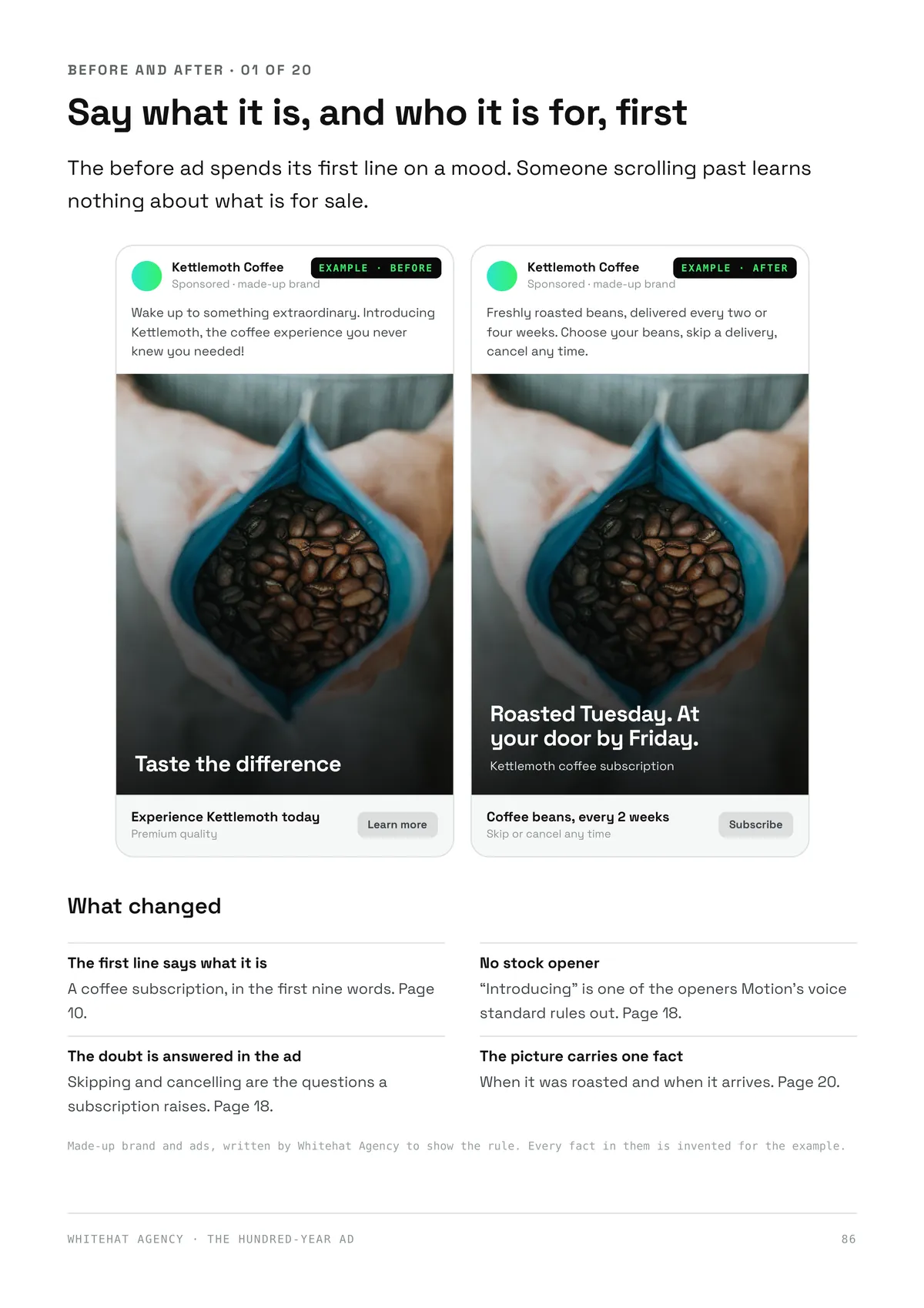
Say what it is, and who it is for, first
The before ad spends its first line on a mood, so someone scrolling past learns nothing about what is for sale. The after ad makes clear it is a coffee subscription within its first nine words.
It also answers the two questions a subscription raises, skipping and cancelling, before the reader has to ask. Each of the 20 before-and-after pairs works the same way: one rule, one made-up brand, and the guide pages that explain the rule.
Twelve of the 131 pages
Select a page to see it full size.
Everything in the guide, page by page
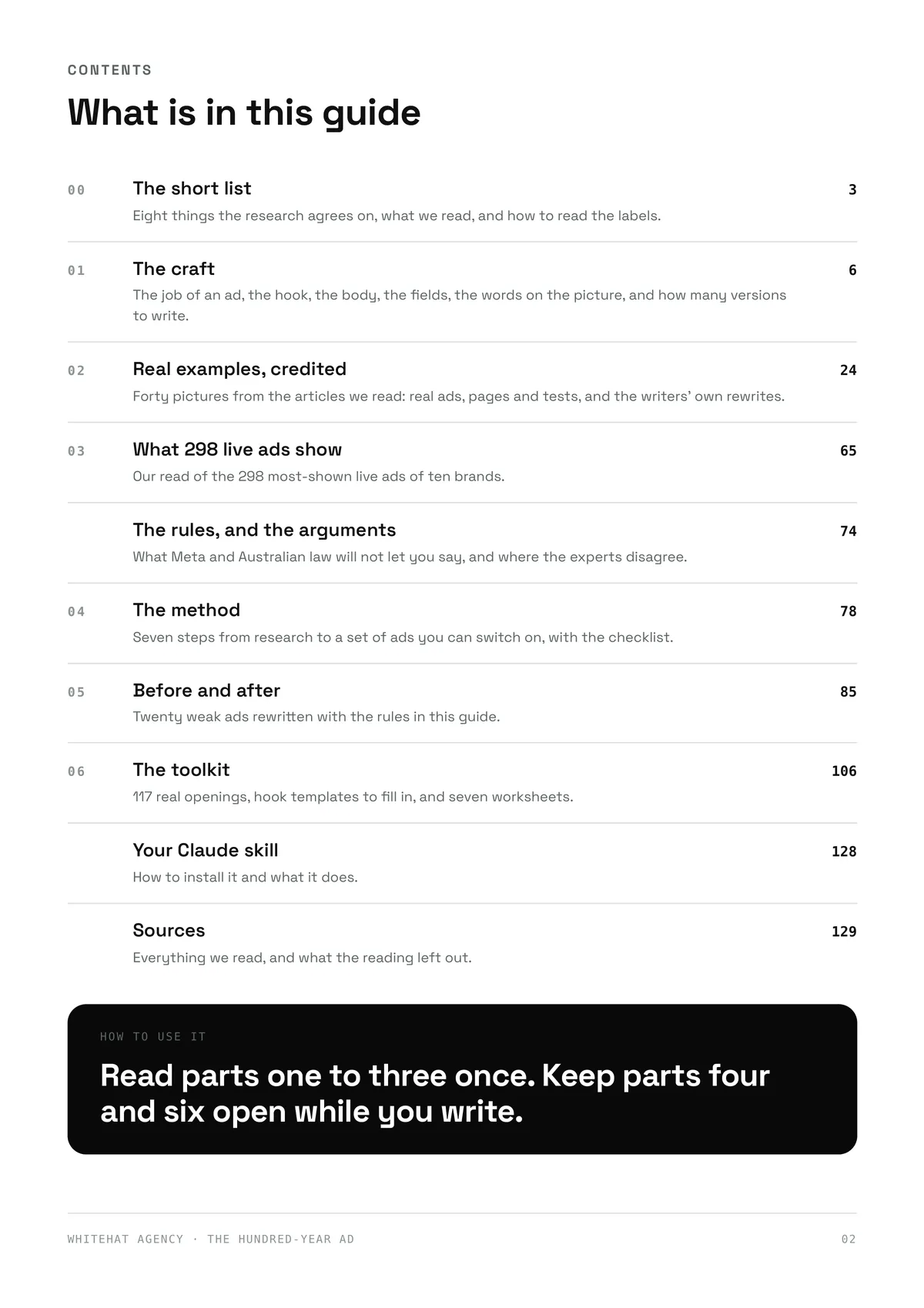
Every section of the guide, with the page it starts on. Open a section to see its chapters.
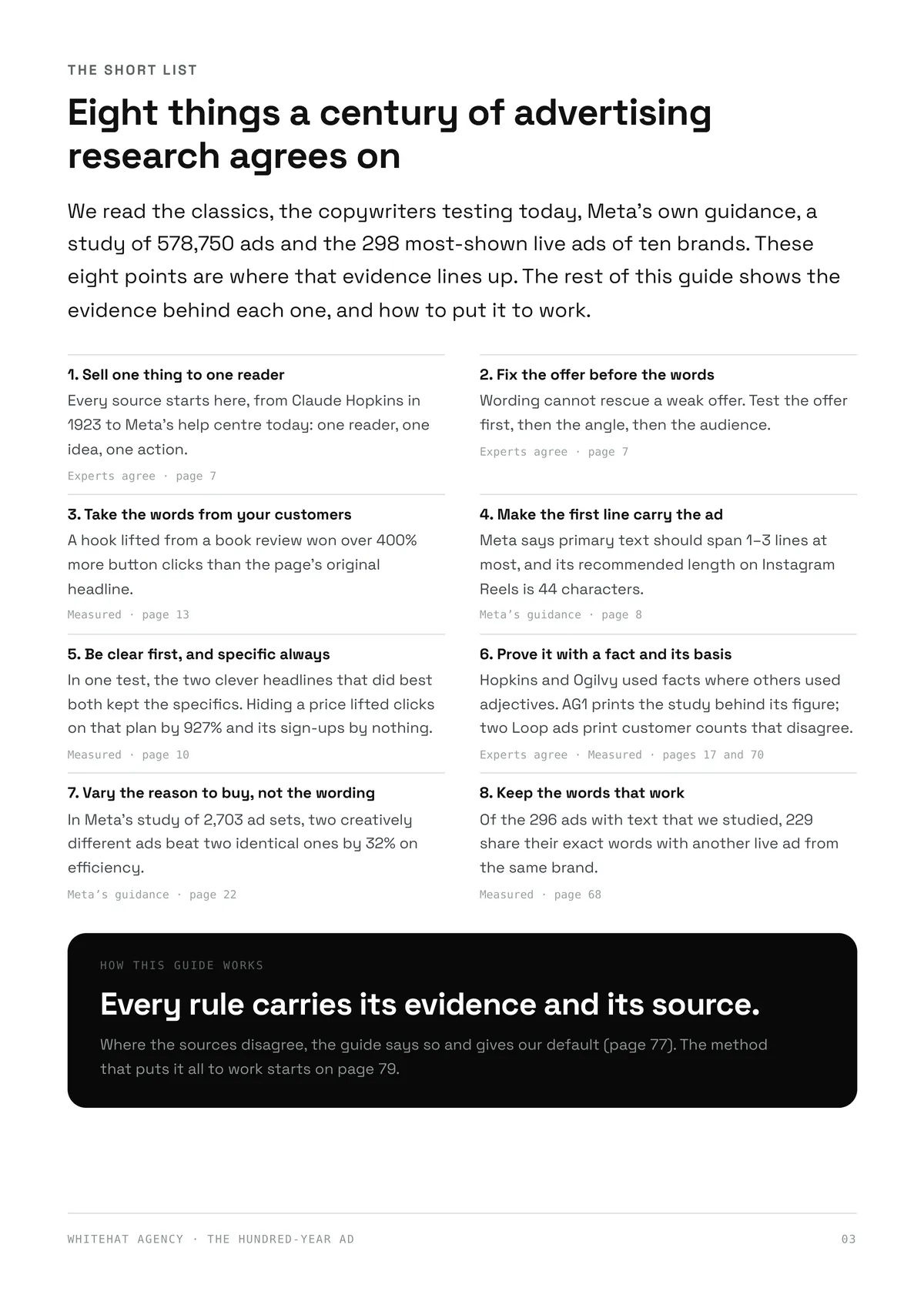
00 The short list Eight things the research agrees on, what we read, and how to read the labels. p. 3
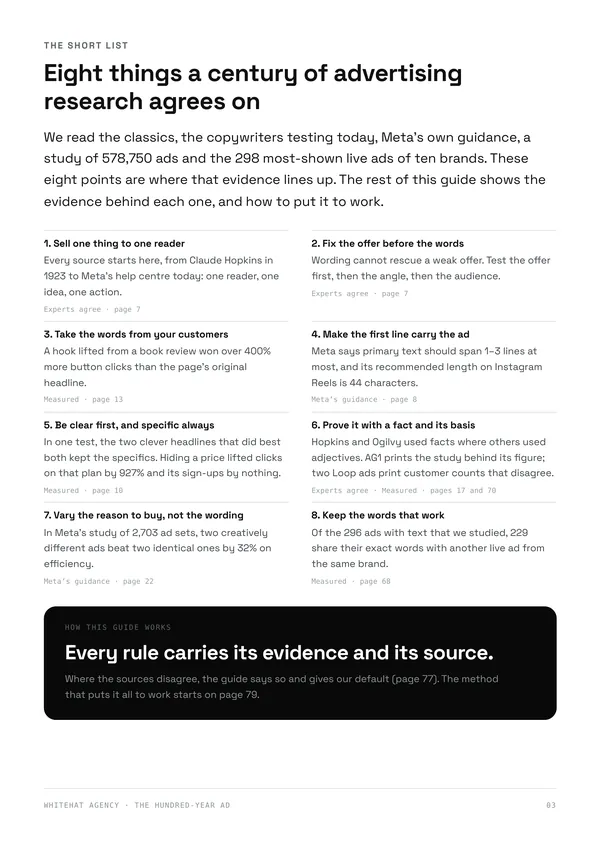
- Eight things a century of advertising research agrees on 3
- What we read, and how much of it 4
- Every rule carries a label saying how strong its evidence is 5
01 The craft The job of an ad, the hook, the body, the fields, the words on the picture, and how many versions to write. p. 6
- An ad sells one thing to one reader 7
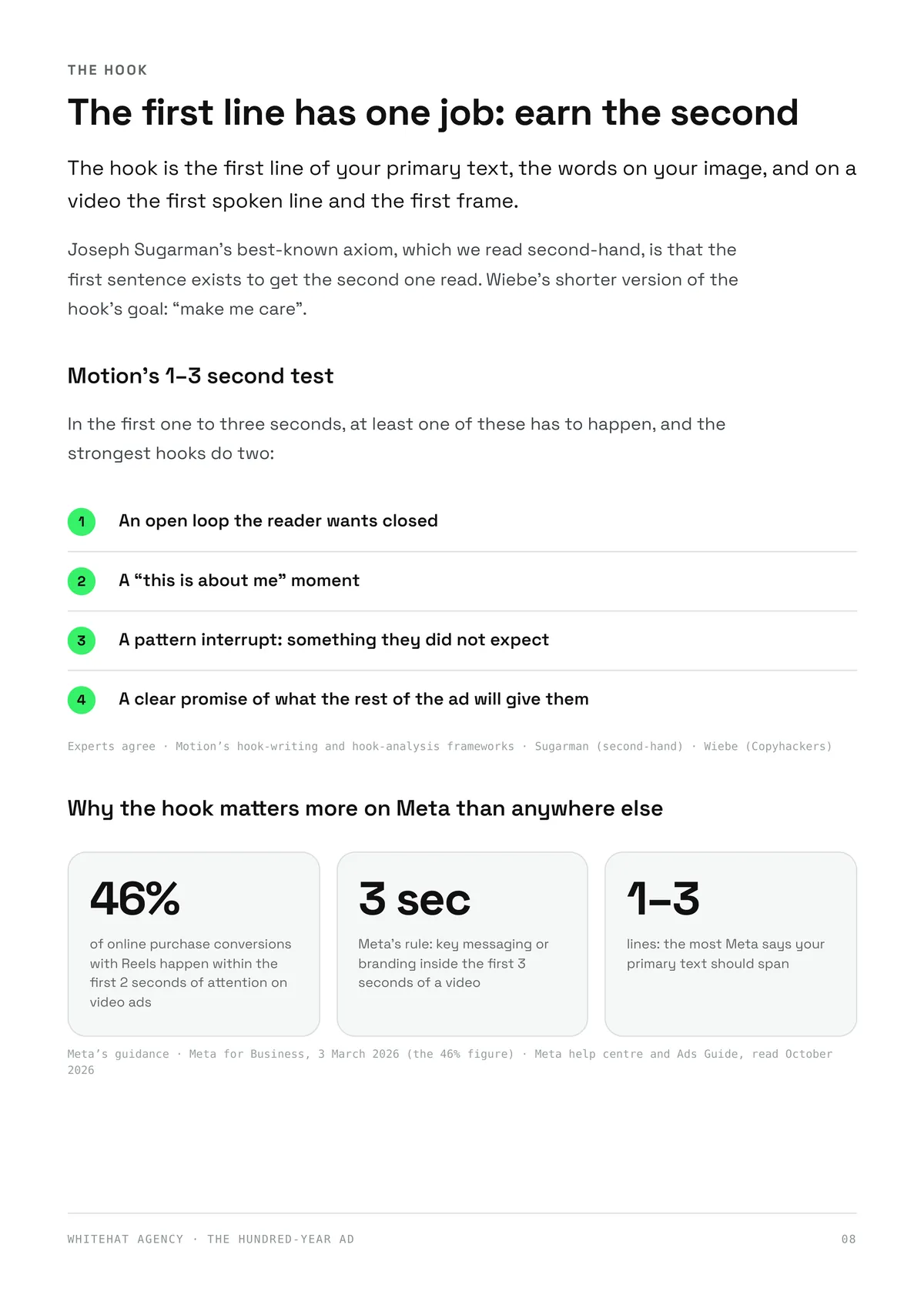
- The first line has one job: earn the second 8
- On a Reel, the hook is nearly all anyone sees 9
- Clear first, clever only if it stays specific 10
- Specific beats general, every time 11
- No hook type is a shortcut 12
- Eight places good hooks come from 13
- Your reviews and comments already hold your best hooks 14
- Match the hook to what the reader already knows 15
- Let the first lines work on their own 16
- Four structures that keep showing up 17
- Answer the doubt where it arises 18
- Every field has to make sense on its own 19
- Text on the image wins more often than teams expect 20
- On video, the words have to agree with the picture 21
- Write different reasons to buy, not different wordings 22
- Plan for most of your ads to lose 23
02 Real examples, credited Forty pictures from the articles we read: real ads, pages and tests, and the writers' own rewrites. p. 24
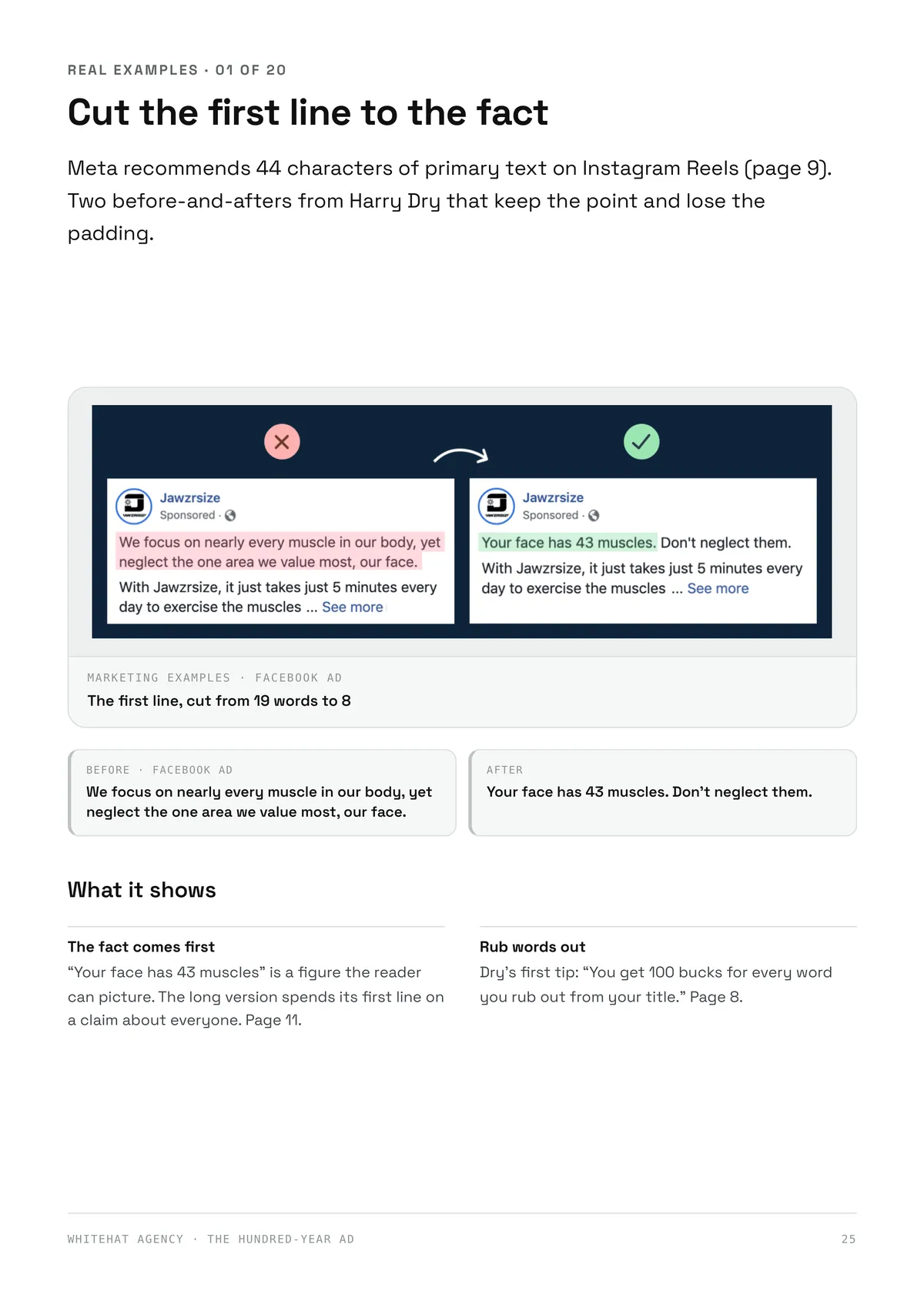
- Cut the first line to the fact 25
- Clear first, and keep the specifics 27
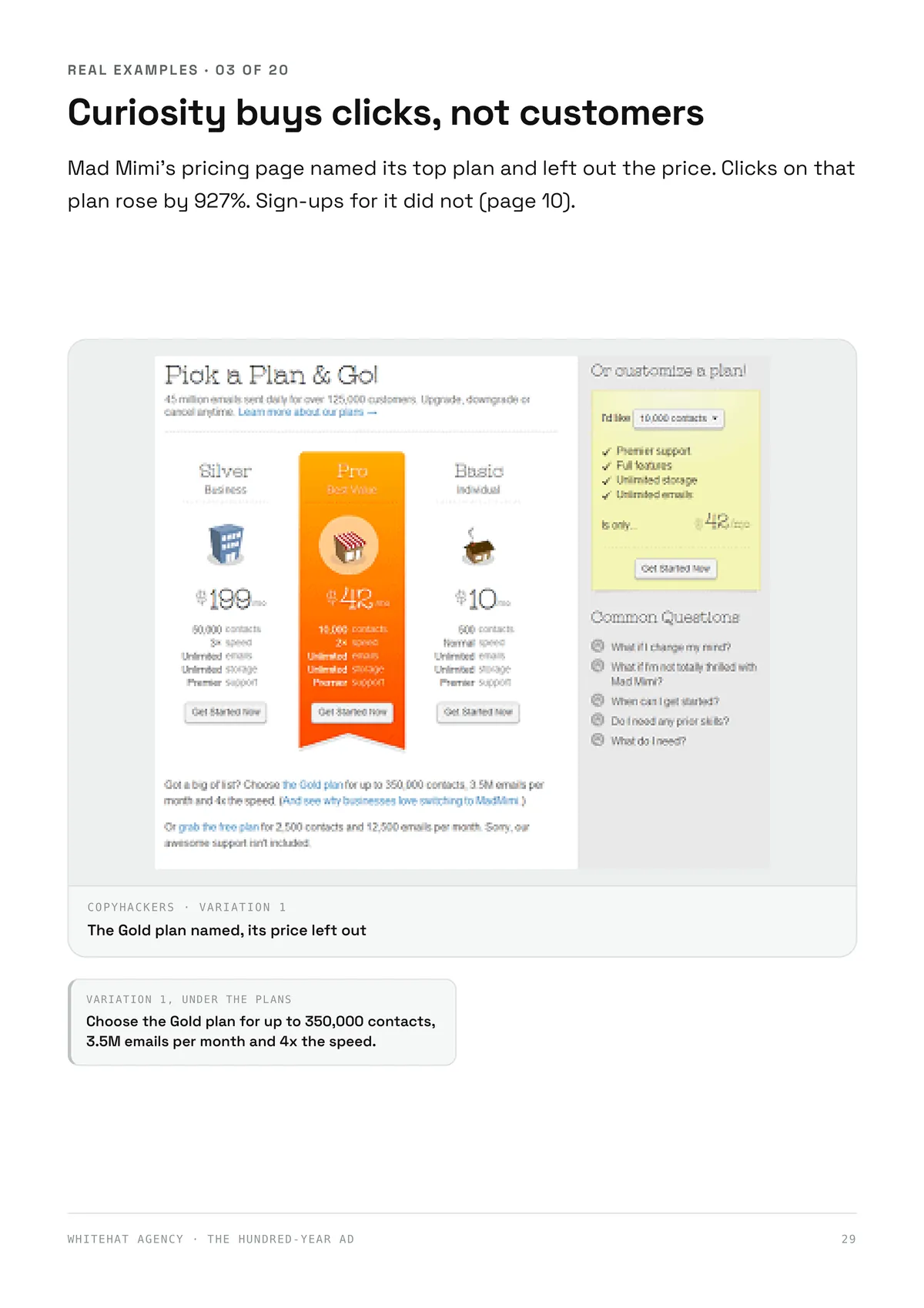
- Curiosity buys clicks, not customers 29
- Say what it does for the reader 31
- A number instead of “more” 33
- Cut the stock words 35
- A stacked list, strongest first and last 37
- Take the words from your customers 39
- Ask the question that gets those words 41
- Open with the problem, or the hope 43
- The reader's question, and the old way 45
- A scene they have lived 47
- How specific, and how much 49
- Answer the doubt in the ad 51
- Say what they get 53
- Write to one reader 55
- Tell the story, not the statistics 57
- Proof is a fact, not an adjective 59
- When the offer is the hook 61
- Break the pattern 63
03 What 298 live ads show Our read of the 298 most-shown live ads of ten brands. p. 65
- We read the 298 most-shown ads of ten brands 66
- The words that have run longest 67
- A text that works is kept, not rewritten 68
- Six openings that recur across brands 69
- Short, specific, and the risk reducer in the description 70
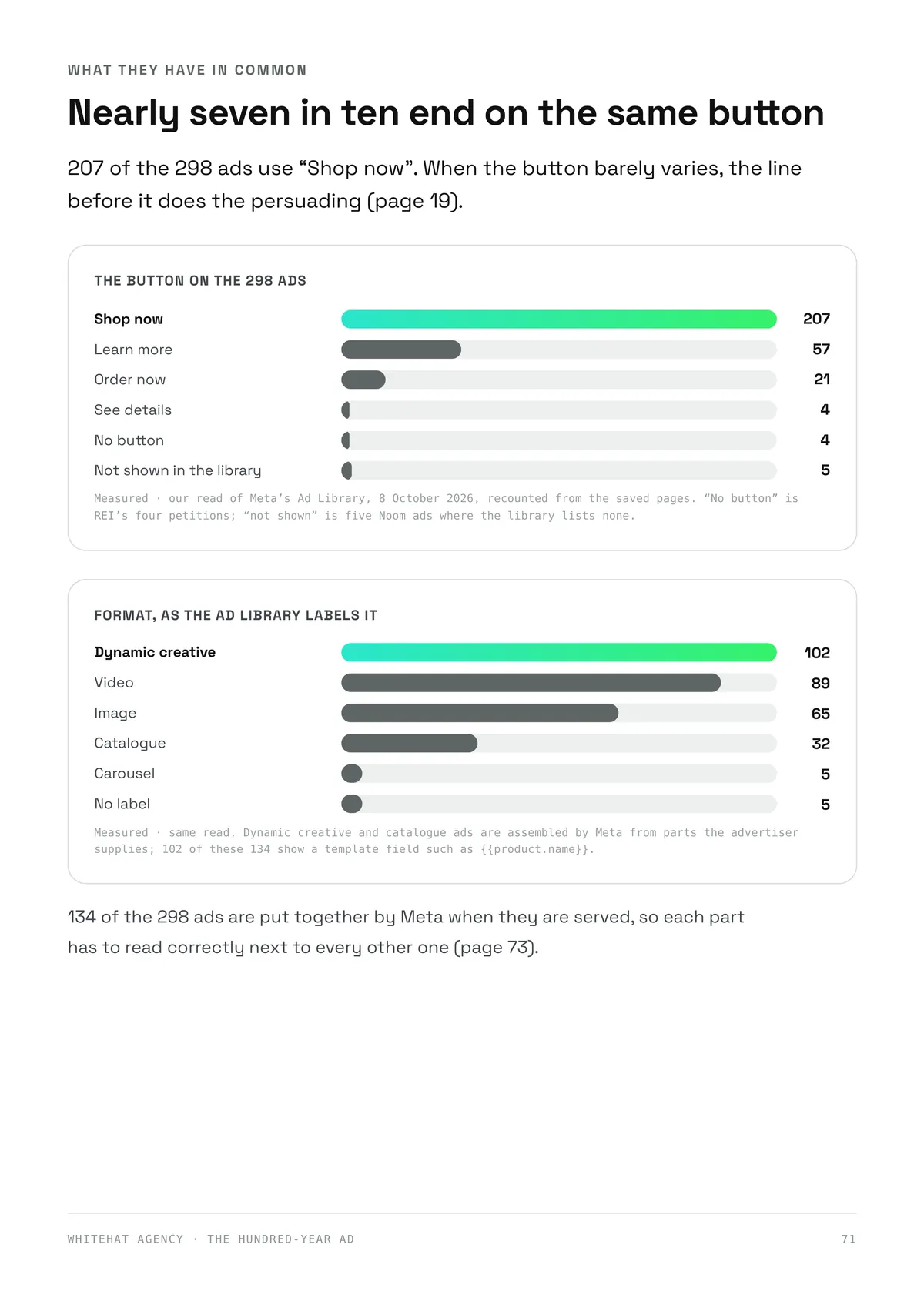
- Nearly seven in ten end on the same button 71
- Most-shown does not mean oldest 72
- Many ads are assembled from parts, and dated lines outlive their date 73
The rules, and the arguments What Meta and Australian law will not let you say, and where the experts disagree. p. 74
- Some of the strongest moves in the research are off limits 74
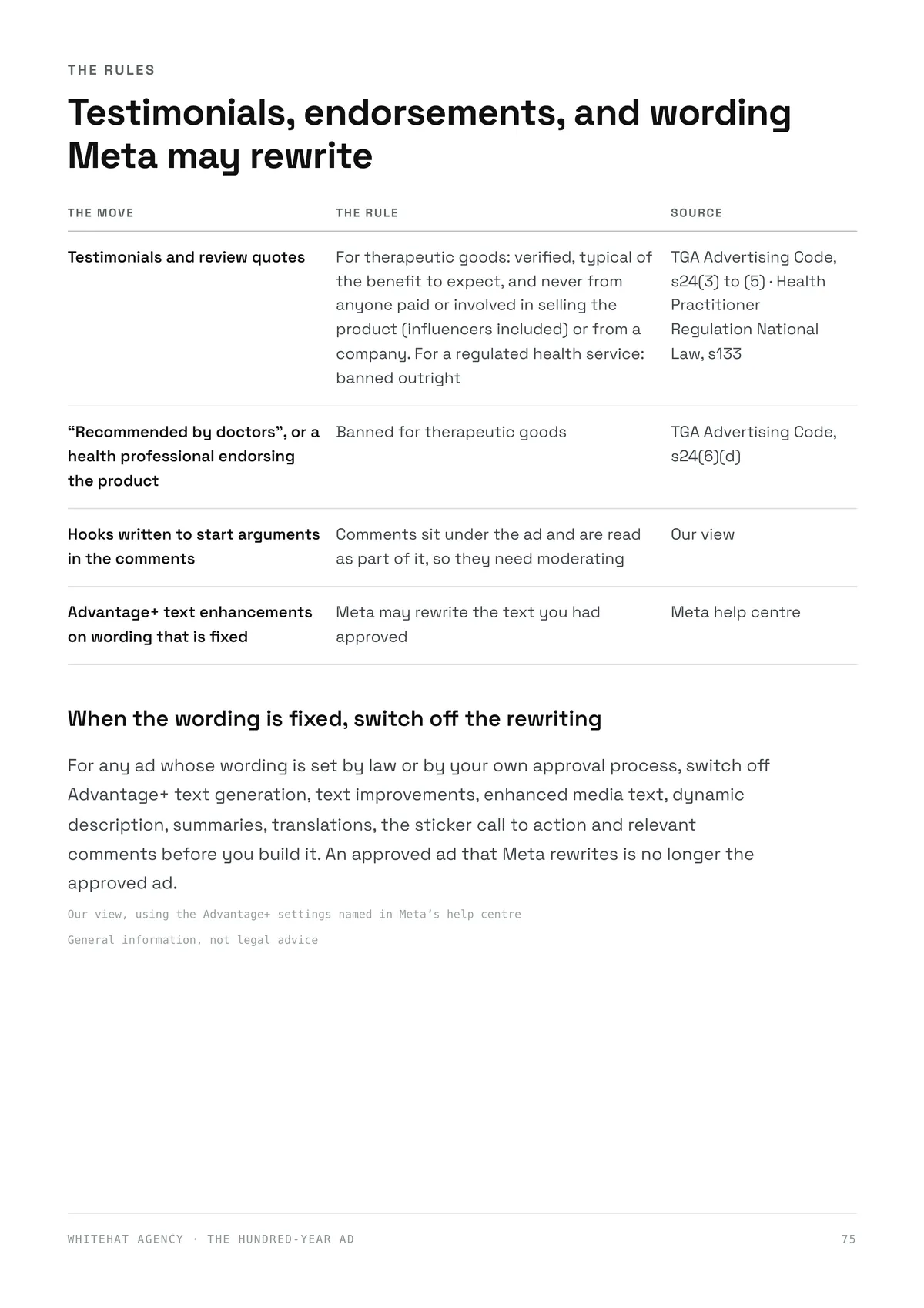
- Testimonials, endorsements, and wording Meta may rewrite 75
- What stays usable when your product is regulated 76
- Six arguments, and the default we use 77
04 The method Seven steps from research to a set of ads you can switch on, with the checklist. p. 78
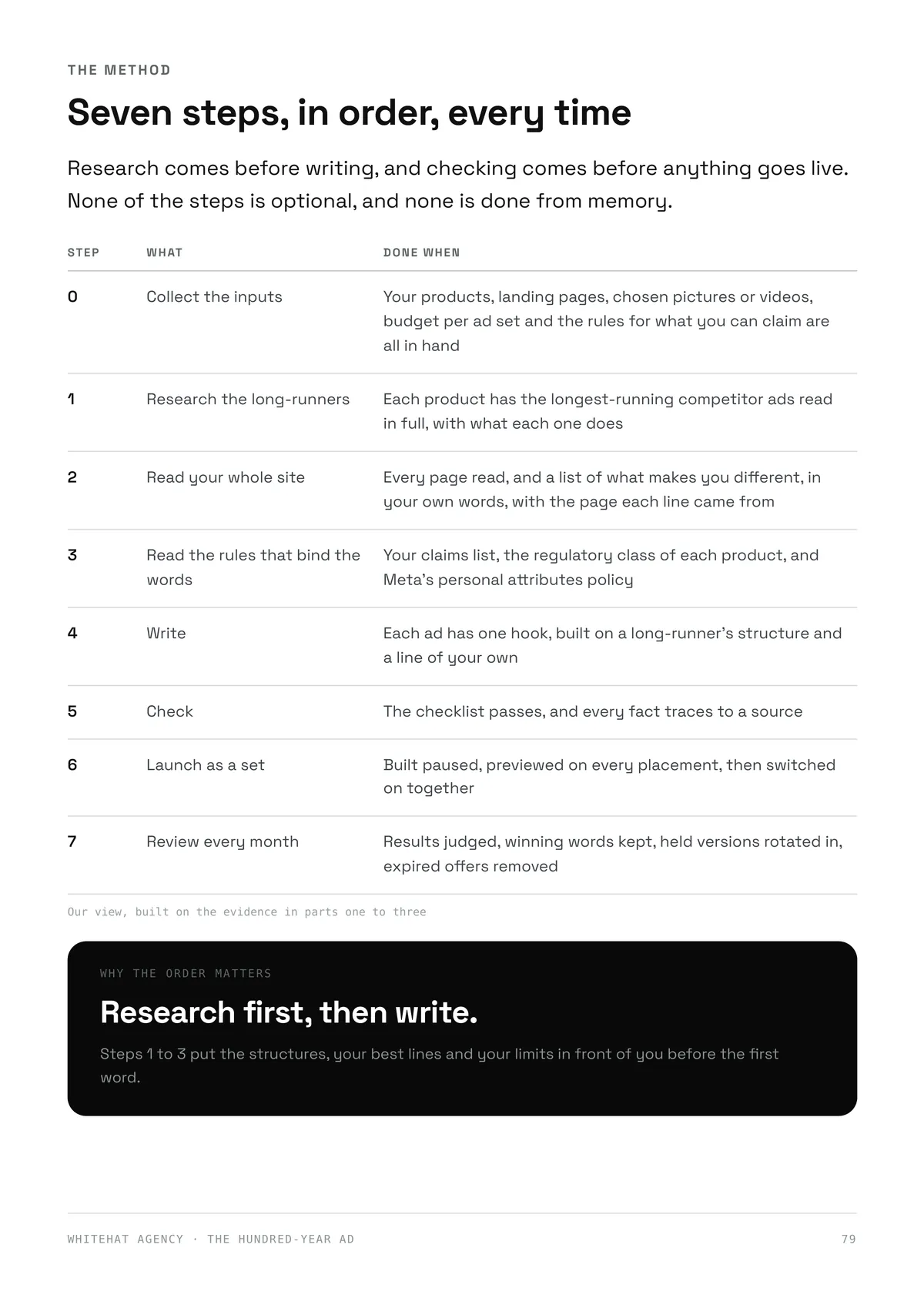
- Seven steps, in order, every time 79
- Find the ads your competitors have run longest 80
- Record what the long-runners do, then read your own site and your rules 81
- Write one hook per ad, built from two halves 82
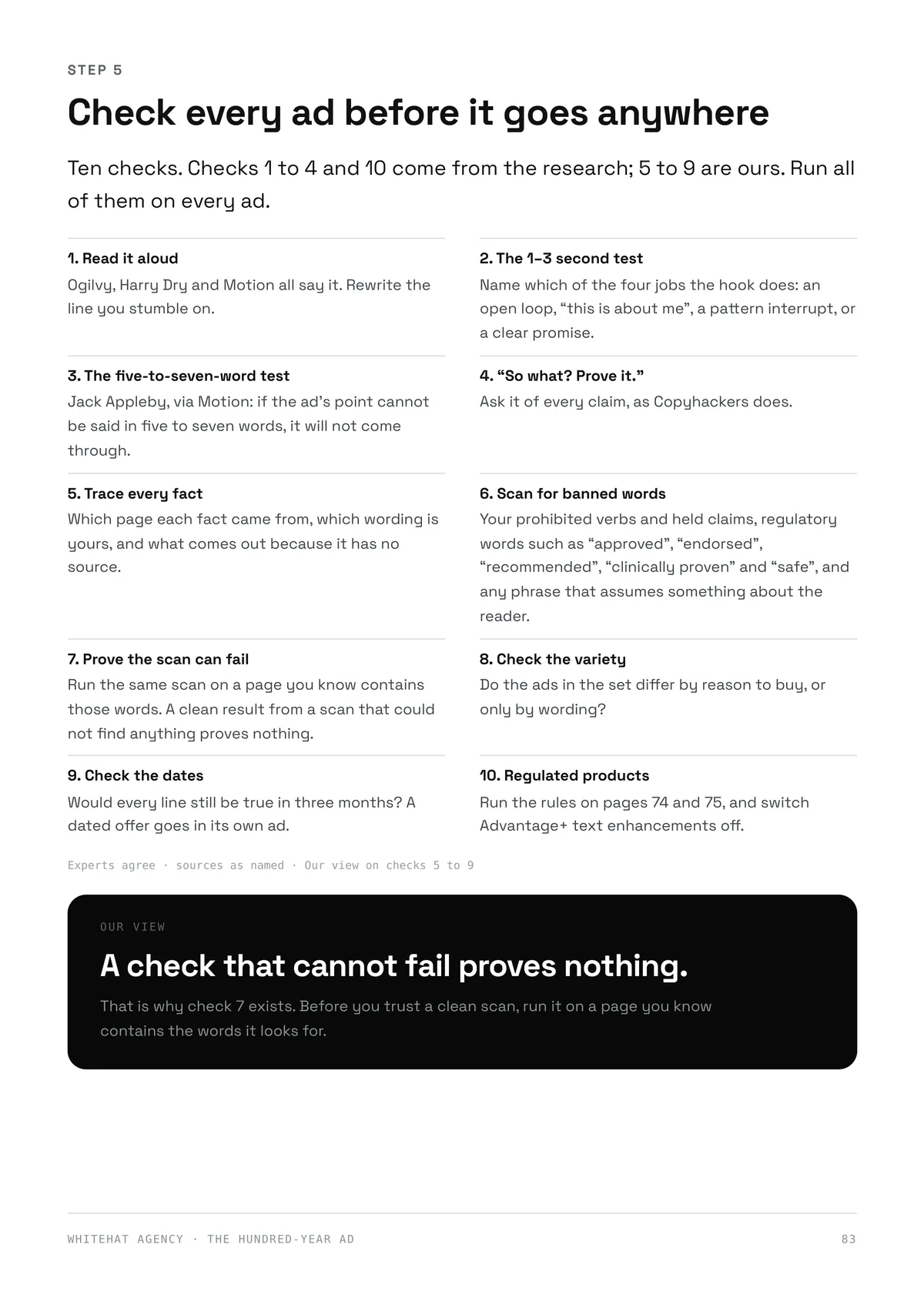
- Check every ad before it goes anywhere 83
- Launch as a set, then review every month 84
05 Before and after Twenty weak ads rewritten with the rules in this guide. p. 85
- Say what it is, and who it is for, first 86
- Swap every adjective for a fact you can prove 87
- Ask the question the reader is already asking 88
- Describe the usual way, then the switch 89
- Set the price against something familiar 90
- Name the moment it gets used 91
- Write about the product, not the reader 92
- Put one message on the picture 93
- Use curiosity only when the ad pays it off 94
- Answer the doubt where it arises 95
- Make every field work on its own 96
- Write the value, not the instruction 97
- Keep catalogue text true for every product 98
- Give a dated offer its own ad 99
- Every number says what it counts 100
- Lift the hook from your reviews 101
- Write to the person buying a gift 102
- If you cannot film it, write it 103
- A confession earns the second line 104
- Correct a misconception with a fact 105
06 The toolkit 117 real openings, hook templates to fill in, and seven worksheets. p. 106
- The openings of the most-shown ads (ten pages) 107
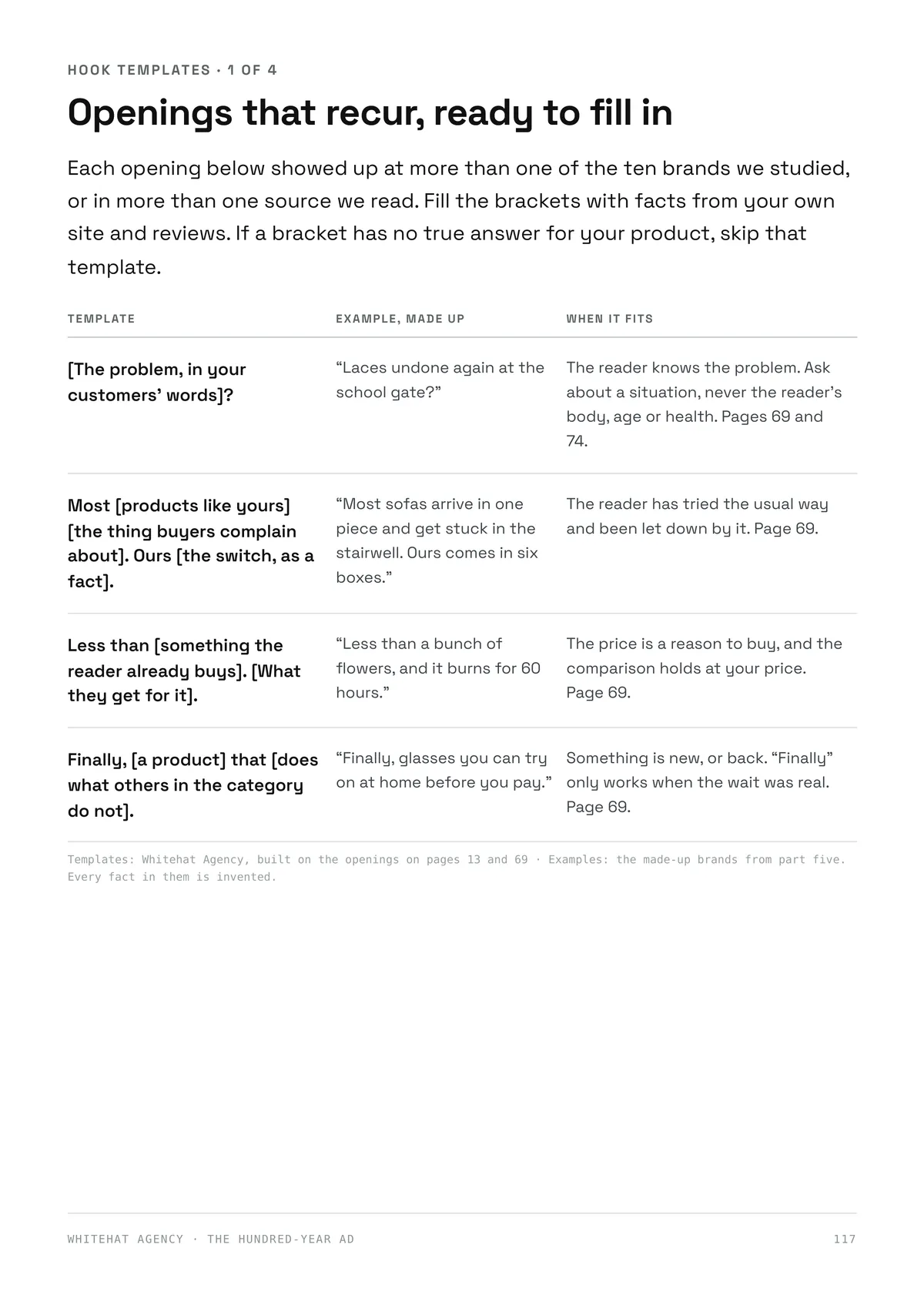
- Openings that recur, ready to fill in 117
- One template for each stage of awareness 119
- The lines after the hook 120
- Worksheet 1: the long-runner log 121
- Worksheet 2: what makes you different 122
- Worksheet 3: your claims and rules 123
- Worksheet 4: the angle planner 124
- Worksheet 5: the ad check sheet 125
- Worksheet 6: the test plan and the launch 126
- Worksheet 7: the monthly review 127
Your Claude skill How to install it and what it does. p. 128
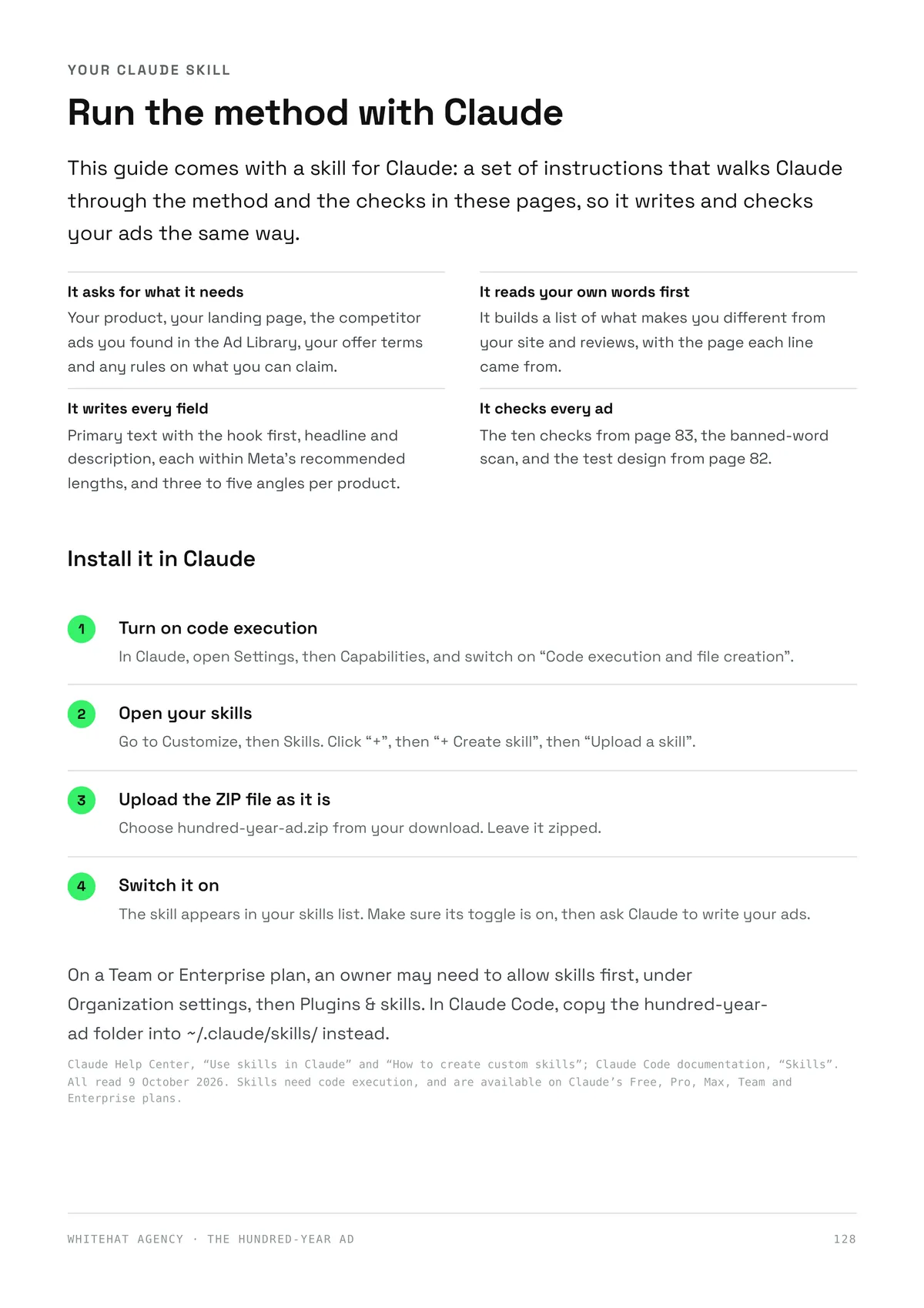
- Run the method with Claude 128
Sources Everything we read, and what the reading left out. p. 129
- Everything we read, and where to find it 129
- The rules we quote, and what the reading left out 130
The method, run for you
Give the skill to your AI assistant once. Then ask it to write your ads, and the skill takes it through the method in the guide, step by step.
- 1
It asks for what it needs
Your product, your landing page, the competitor ads you found in Meta's Ad Library, your offer terms and any rules on what you can claim.
- 2
It reads your own words first
It builds a list of what makes you different from your site and reviews, with the page each line came from.
- 3
It writes every field
Primary text with the hook first, then the headline and description within Meta's recommended lengths. Three to five angles per product.
- 4
It checks every ad
The ten checks, a scan for banned and regulatory words with a test that proves the scan can fail, and a three-ad test design. Anything it cannot source, it lists for you.
What its checker found in a made-up skincare ad
Real output from the skill's checker script, run on the before ad from page 92 of the guide. The two REVIEW lines name the TGA Advertising Code and Meta's policy, and every number in the ad is listed for a source.
A script finds words, not meaning, so the skill also has the AI read every line against Meta's personal attributes policy, the rule this ad breaks first.
Ad before
  REVIEW [headline] "Miraculous": a banned representation for therapeutic goods (TGA Code s9(1)): Anti-ageing miracle cream
  REVIEW [description] A set result in a set time: Meta bans promises of specific outcomes within a set time frame without disclaimers in a health context; elsewhere it is a claim that needs a source: Results in 7 days
  TRACE  [primary_text] A number: say what it counts and where it comes from: Ready to look 10 years younger? Say goodbye ...
  TRACE  [description] A number: say what it counts and where it comes from: Results in 7 days
  TRACE  [image_text] A number: say what it counts and where it comes from: Look 10 years younger
  INFO   [primary_text] Hook: 88 characters. On Reels about 44 show: "Ready to look 10 years younger? Say goodbye " ...
Install it in Claude in four steps
- Turn on code execution In Claude, open Settings, then Capabilities, and switch on “Code execution and file creation”.
- Open your skills Go to Customize, then Skills. Click “+”, then “+ Create skill”, then “Upload a skill”.
- Upload the ZIP file as it is Choose hundred-year-ad.zip from your download. Leave it zipped.
- Switch it on The skill appears in your skills list. Make sure its toggle is on, then ask Claude to write your ads.
Skills need code execution, and are available on Claude's Free, Pro, Max, Team and Enterprise plans. On a Team or Enterprise plan, an owner may need to allow skills first. In Claude Code, copy the skill's folder into ~/.claude/skills/ instead. Claude Help Center and Claude Code documentation, read 9 October 2026. Page 128 of the guide has the same steps.
Every rule shows its evidence
Each rule in the guide carries one of four labels, so you can see how much weight it holds, and a source line that names where it came from.
Measured
A named test, study or count with a number and a sample.
Experts agree
Several independent sources recommend it, with no hard number behind it.
Meta's guidance
What Meta documents about its own platform, read in October 2026.
Our view
Whitehat Agency's own judgement from running ads, labelled as ours.
Made by Whitehat Agency, a Sydney digital marketing agency, white-hat since 2013. We run SEO, Google Ads, Meta Ads, web design and AI work for Australian businesses, and we are a Google Premier Partner and a Meta Business Partner.
Australian business owners and marketers who write their own Facebook and Instagram ads to sell products online.
- Anyone after ads with no research behind them. The method starts with the ads your competitors have run longest and your customers' own words.
- Anyone who needs legal sign-off. The rules chapter is general information, so a regulated product still needs a qualified review before an ad runs.
The Hundred-Year Ad
- The 131-page guide, as a PDF
- The AI skill, as a ZIP file, for Claude, ChatGPT, Gemini, Copilot and other assistants
- 40 real examples from copywriters' articles, credited
- 20 before-and-after rewrites, one rule each
- 117 openings from live ads, plus hook templates
- 7 worksheets, one for each step of the method
- The rules for Australian advertisers: the TGA Advertising Code, the National Law, the ACCC and Meta's policies
30-day money-back guarantee. If the guide and skill are not for you, email
marketing@
We email your download link once the payment goes through.
Questions about the guide, answered.
What is in The Hundred-Year Ad?
A 131-page ad copywriting guide as a PDF and an AI skill as a ZIP file, for $97 including GST in one payment. The guide covers the craft, 40 real examples, a study of 298 of the most-shown live ads of ten brands, the rules for Australian advertisers, a seven-step method, 20 before-and-after rewrites and a toolkit with seven worksheets.
How do I write ad copy that sells?
The research behind the guide agrees on eight points. Sell one thing to one reader. Fix the offer before the words. Take the words from your customers: a hook lifted from a book review won over 400% more button clicks than the page's original headline. And make the first line carry the ad, because on Instagram Reels Meta recommends 44 characters.
Are the examples real ads?
Part two's 40 pictures are real ads, pages, emails and test results from articles by Copyhackers and Marketing Examples, each credited to its writer, article and date. The swipe file quotes 117 openings word for word from 260 live ads. The 20 before-and-after rewrites use made-up brands, and every one of those pages says so.
Does the skill work with ChatGPT, Gemini or Copilot?
Yes. The skill is the guide's method written as plain-text instructions in the open Agent Skills format, with a checker script. Claude, ChatGPT on Business, Enterprise and Edu plans, Microsoft Copilot Studio and Gemini CLI load it as a skill. In any other AI assistant, unzip it, attach or paste SKILL.md and the four files in its references folder, and ask the assistant to follow SKILL.md. The checker is a Python script: it runs where your assistant can run code, and where it cannot, the skill has the AI run the same checks by reading. The 131-page guide stands on its own without any AI.
Is it written for Australian businesses?
Yes. It is written in Australian English for businesses that sell online here. Pages 74 to 76 cover the TGA Advertising Code, the Health Practitioner Regulation National Law and the ACCC alongside Meta's own policies. That chapter is general information, not legal advice, so a regulated product still needs a qualified check before an ad runs.
Will it make my ads work?
The guide gives you a method that plans for misses. In Motion's study of 578,750 ads, about 5% became winners, so you write three to five different angles, launch them as a set and keep the words that win. And if the guide and skill are not for you, you get your money back within 30 days.
What format are the files, and what can I read them on?
The guide is a 131-page PDF of about 13 MB, laid out at A4, so it opens in any PDF reader on a computer, tablet or phone. The skill is a single ZIP file of about 35 KB. Claude and the other assistants that take skills load it as it is; for any other assistant, you unzip it and attach or paste its text files.
How do I get the files?
Pay at the checkout and we email you a private download link once the payment goes through. The link gives you both files, the 131-page guide and the skill, so you can start reading straight away and install the skill when you are ready to write your ads. The link works for 30 days. After that, email marketing@whitehatagency.com.au and we will send you a new one.
What if it is not for me?
If the guide and skill are not for you, email marketing@whitehatagency.com.au within 30 days of buying and ask for your money back. The 30-day money-back guarantee covers your $97 including GST for the 131-page guide and the AI skill together, because both come in one payment.
The Hundred-Year Ad
A 131-page guide and an AI skill. $97 including GST, with a 30-day money-back guarantee.